
Identify a Pulaski County Owner
Ownership in Pulaski County is a chain of small checks rather than one database answer. Pin down the location first. Then match it to a parcel on the tax roll. The assessor's owner field gives the name of record. That name leads to the newest deed. Hyphens, dots, and leading zeros all matter. Street spellings will not hold still across offices. Used in order, these sources answer the practical question. They do not confuse the tax bill with the recorded conveyance.
- Enter the address in Pulaski WebGIS. If it fails, try the road name, owner surname, or parcel fragment.
- Open the parcel result's Card and note the owner of record, situs address, mailing address, and full parcel number.
- Search that owner as grantee in the Pulaski Recorder's Doxpop index. The newest deed into that grantee is the recorded check.
- When an LLC is named, use Indiana's INBiz search for the entity record. A trust or estate may instead require deed or probate context.
The result is a legal owner of record. It says nothing about who lives on the land. A mailing address may simply be a trustee, a post-office box, or an office that receives the county's tax notices.
Read the Pulaski Owner Result
The county's owner-name search asks for a last name and takes an optional first name. Results list the parcel number, owner, property address, and mailing address. That mix saves time. Zoom pins the parcel on the map. Card opens the assessment detail, including land, improvement, and total values, legal and physical traits, caps, a change reason, and collector and appraiser dates. This pairing helps when a rural-road spelling varies or one owner holds several tracts.
Neither action makes the screen a certified title statement. A name can carry an AKA. The mailing-address field may show a different form of the name, so search each version. The county-linked owner result shows the Card view. It also shows how Zoom ties a name to a single parcel.
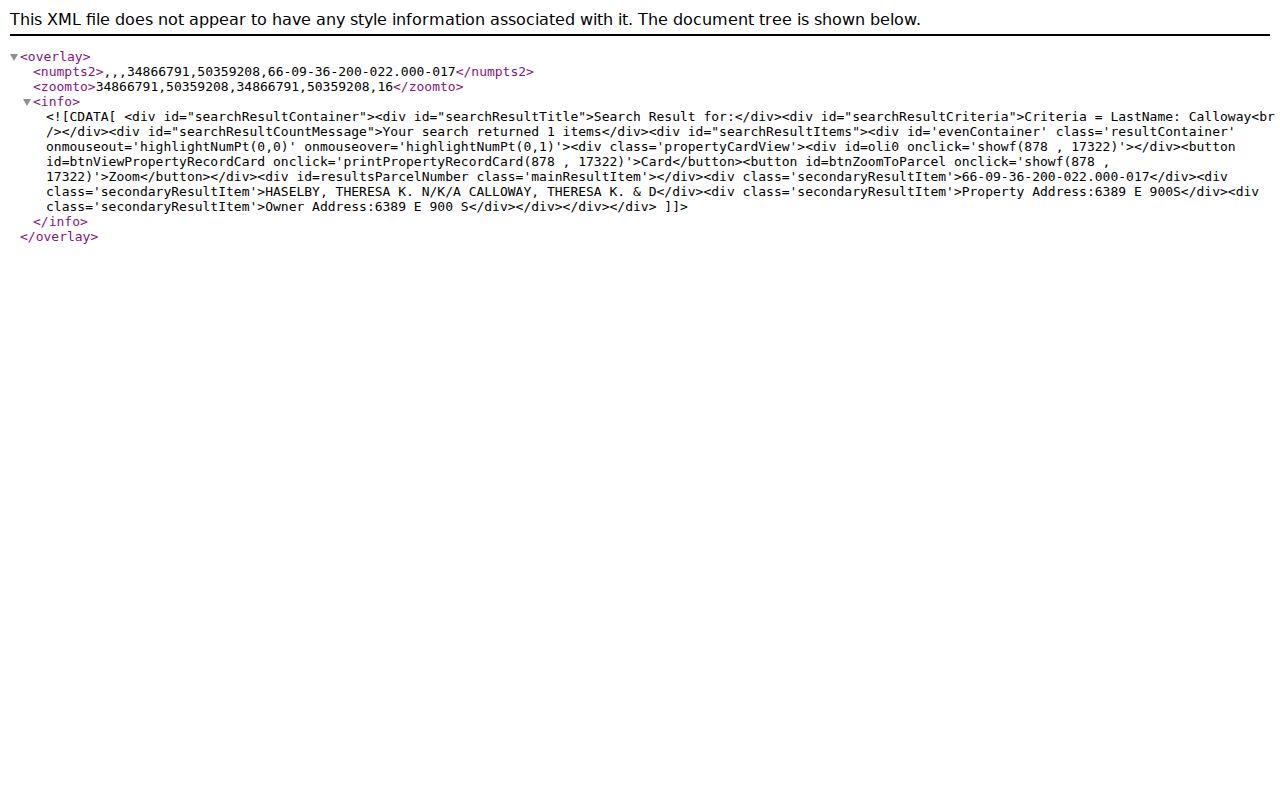
Treat the screen as a locator for the parcel. It points you to the owner of record. From there, the Pulaski County deed index supplies the next check.
Pulaski County Address Clues
Three address forms describe one parcel in Pulaski County. A situs address shows where a building sits. A mailing address shows where the county sends notices. The legal description identifies the land in title language, often a town lot and block, a subdivision, section and township, or metes and bounds. None of the three has to match word for word to point at the same tract.
- Owner of record
- The person or entity named on the current public assessment roll.
- Vesting
- The way title is held, as stated in the deed.
- Grantee
- The party receiving an interest through a recorded instrument.
- Situs address
- The location of the parcel, which may differ from the owner's mailing address.
Rural records often use directional county-road addresses. Try abbreviations both ways, but keep the exact form shown in the source. A brand-new site can lack an address entirely. The Sheriff's 911 process can assign one from the owner, the parcel, coordinates, or a clear location description.
Trace Pulaski County Ownership Sources
No single Pulaski County office answers the whole ownership question. The tax roll carries an administrative owner name. WebGIS places that name on a mapped parcel. The Recorder keeps the deed that moved the interest, and Indiana's business search can explain a company name, though it never replaces the deed itself.
| Source | Owner Info It Gives | Access |
|---|---|---|
| Assessor card | Owner of record, situs and mailing clues | WebGIS or Assessor office |
| Recorder deed index | Grantee on the latest recorded deed | Doxpop from January 1994; older books at Recorder |
| INBiz entity record | Business status, address and registered agent | Free state search |
| WTHGIS map | Owner-linked parcel, Card and Zoom | Free county-linked viewer |
The strongest match rests on both name and land. Check the parcel number on the deed. Never assume every same-name hit is the right tract, since common surnames, initials, trusts, and estates invite mix-ups.
Confirm the Pulaski County Grantee
The Pulaski County Recorder files deeds, mortgages, liens, leases, plats, releases, and related instruments. In Doxpop, search the assessor's name as a party. Narrow the results by deed type and date. Then compare the parcel or legal-description terms. Warranty, quitclaim, sheriff's, tax-title, executor's, administrator's, corrective, transfer-on-death, and corporate deeds can each change the answer.
Doxpop's index and scanned images start in January 1994. Basic index facts are free. Detailed or image access may carry a charge. The vendor index is not the official record. For an older or uncertain instrument, contact the Recorder in Room 102 at the Pulaski County Courthouse or consult the older books directly.
Note: A recent sale can appear in the Recorder's index before the assessor finishes its next roll update.
Decode Pulaski County Entity Owners
An owner field may name a trust, estate, bank, corporation, or limited-liability company rather than a person. Copy the entity name exactly, punctuation and all. Search the variants. For an Indiana business, INBiz returns the entity ID, status, address, registered agent, and filing history. Those facts separate look-alike names. Neither fact shows occupancy or ownership by the agent.
Trusts and estates need a different route. Search Doxpop for the full name, the trustee or personal representative, and the deed type. Probate filings may live with the Pulaski County Clerk and Indiana MyCase. Use them only when the recorded deed leaves a gap in the transfer story.
Check Pulaski County Roll Lag
Pulaski County promises no fixed lag between a deed recording and the assessment roll catching up. So skip assumptions about update schedules. The newest recording date is the better guide. When the assessor's owner of record clashes with the newest deed, line up the grantee, the parcel, the legal description, the deed date, and the recording date. If the mismatch still stands, ask the Assessor whether a transfer is pending.
The Auditor tax list offers a second clue. It labels itself "Not for Official Use." The Auditor also warns that a parcel split or combination within the last two years may call for a last-name search across all tax bills. A split can leave old and new parcel references hanging on one place, so the tax roll name alone should never settle who owns it.
Watch Pulaski County Deed Activity
Doxpop runs a free watch for a property or a name. It flags new recorded activity tied to either one. An owner can use it to catch a deed, lien, or other filing tied to a watched name or legal description. Rural legal descriptions can trigger false positives. Treat an alert as a prompt to inspect the instrument. It is not proof that title changed. The Doxpop Property Watch route shows the account-based alert entry point.
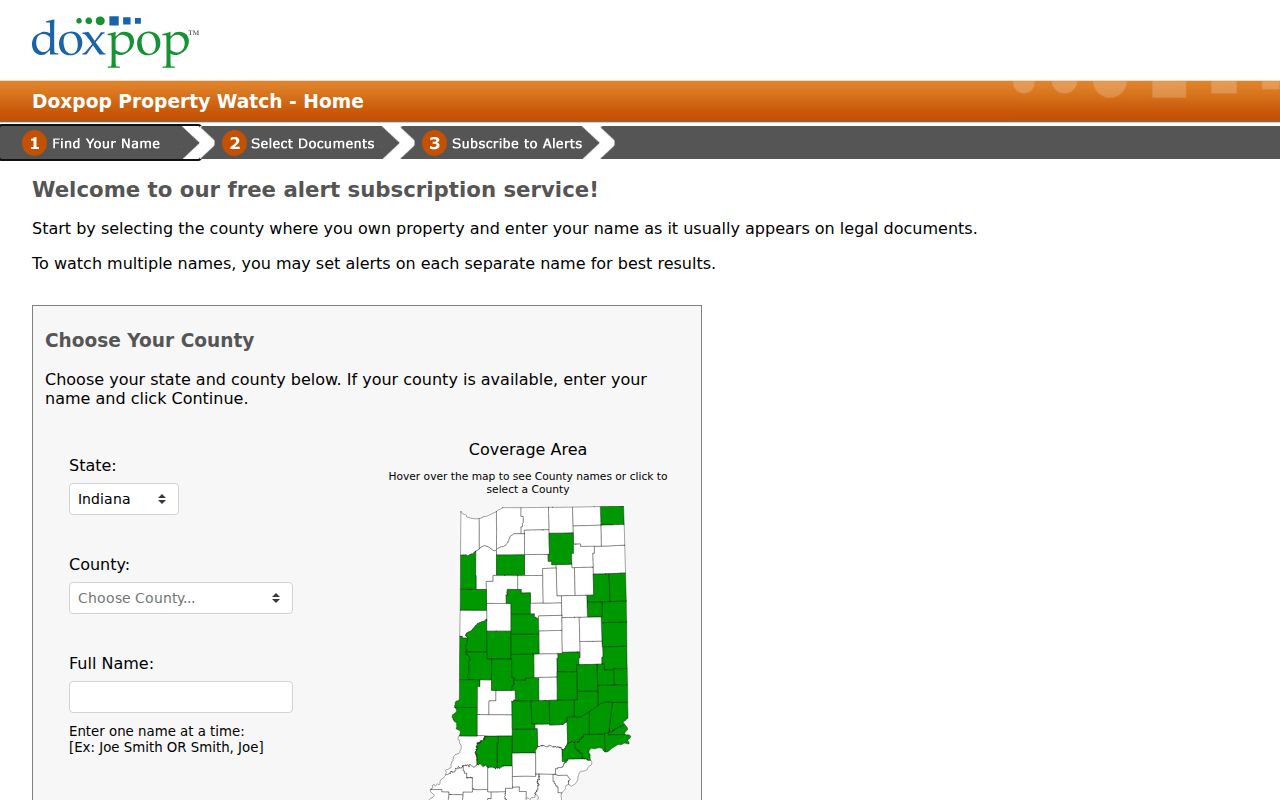
Before acting on any alert, compare it with the parcel and the Recorder record. A name match alone can sweep in unrelated land.
Request a Pulaski Owner Record
When the portals leave the owner of record unresolved, the county's public-access form is the fallback. Indiana APRA, Indiana Code § 5-14-3, allows inspection and copying subject to exceptions. Pulaski County asks for a department and a description framed with reasonable particularity. Name the address, the parcel number, the possible owner, and the record type. Add the date range. State whether you want inspection, an electronic file, or a paper copy. You can also request a certified copy.
Start with the Assessor for the current property card. Go to the Recorder for recorded title instruments. Standard county copy fees are $0.10 per black-and-white page and $0.25 per color page. Recorder and Doxpop charges follow their own schedules. Ask for an estimate before any large request.
Limit a Pulaski Owner Lookup
A public record can name the assessed owner or the recorded grantee. It cannot prove who lives at an address. Nor can it replace a complete title defect analysis. Indiana's Address Confidentiality Program substitutes a designated address for eligible participants. Protected fields may also be withheld under law. An apparent gap can therefore reflect lawful protection rather than a bad property search.
Lawful use. Pulaski County owner records support purchase research, boundary work, estate matters, and civic review. Never use an owner's details to stalk, target, intimidate, or harm anyone.
A sale or boundary dispute needs work that no public screen can do. Bring in a title professional or a surveyor. The goal is a well-matched record trail: parcel to assessor name, assessor name to current deed, and that deed back to the official custodian.