
Trace Back Pulaski County Owners
Former-owner work moves from the newest known deed toward older evidence. Record each transfer as a row. Do this before taking the next step. The date, grantor, grantee, deed type, and book/page or instrument number create an audit trail and expose breaks that need a probate, court, plat, or corrective record.
| Transfer Date | Grantor → Grantee | Deed Type | Book/Page |
|---|---|---|---|
| Newest match | Prior owner → current grantee | Copy exact type | Copy cited reference |
| Next earlier deed | Earlier owner → prior owner | Copy exact type | Copy cited reference |
| Continue backward | Repeat with each grantor | Note probate or correction | Keep each source |
Doxpop carries the modern chain. Its Pulaski index and images begin in January 1994. For earlier owners, turn to the Recorder vault and the Indiana State Library's county microfilm and plat holdings.
Cross Pulaski's 1994 Divide
The Doxpop county table places the Pulaski County index and image start at January 1994. Basic index details are free. Detail or image access can carry a charge, and Doxpop says its index is not the official record.
Online boundary. Pulaski County's online Recorder coverage begins in January 1994. Earlier former owners require deed books, courthouse research, or archival sources.
The captured coverage screen documents the handoff.
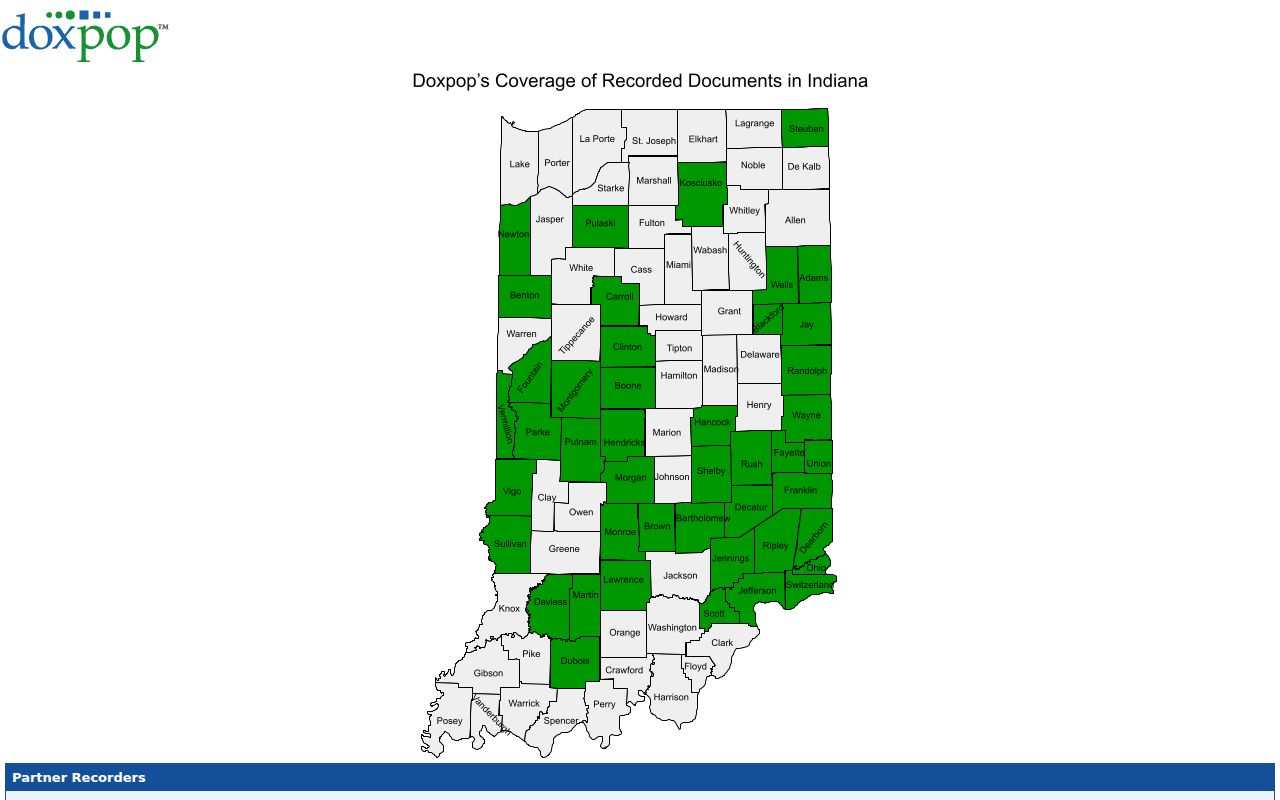
Save the last online legal-description clue before moving into older volumes.
Reconstruct Pulaski Deeds in Reverse
Find the current grantee's acquiring deed first. Search that grantor as an earlier grantee. Repeat while the legal description still matches, drawing on party, date, document type, document number, ID, and Book/Page fields from the index.
- Find the current owner's deed with that party as grantee.
- Record the grantor, date, type, reference, and land.
- Search that grantor as grantee for the earlier transfer.
- At January 1994, carry the references into deed books.
- Grantor
- The party conveying an interest.
- Grantee
- The party receiving it.
- Chain of title
- The linked sequence of recorded transfers.
- Reverse index
- An index used to search grantors or grantees.
- Quitclaim and warranty
- Different deed forms that must be recorded exactly.
Track the lot and block, the subdivision name, the section and township, the metes and bounds, or the parcel number at each step of your search. A name by itself proves little in Pulaski County property records.
Go Back Through Pulaski Books
Pre-1994 deed, mortgage, lien, and plat volumes stay offline. The courthouse and archives hold them, since exact volume runs are not posted. The Indiana State Library guide confirms the microfilm leads. Its Pulaski maps span 1873 through 2023, including a 1906–07 Standard Atlas and later landowner-indexed plat books.
Maps must generally be viewed at the State Library. They do not loan. Note the title and call number. At the Recorder, bring the last online party, description, and book/page clue.
The 1997 Pulaski County plat book carries city street maps and an owner index, giving a pre-GIS ownership snapshot. The 2023 edition bridges rural roads, township maps, and city streets. An atlas name is not a transfer. Use it to find the tract and spelling. Then return to the deed book for the grantor, grantee, date, and legal description, citing the exact atlas page so a later reader can repeat the search.
Reach Pulaski's First Entries
The Indiana State Archives' LaPorte–Winamac land-office index is a distinct early lead. A land entry can predate the federal patent. Entries may note prior residence, and a GLO patent marks the federal-to-private endpoint, not the later chain.
Purchase and patent dates can differ. Record both and label the source of each. That detail can keep a first private owner from landing in the wrong year, and it can separate an entryman's early claim from the later federal document.
Pulaski County was created in 1835. Official sources describe organization as 1839 or 1840 in different accounts. Preserve that discrepancy rather than choosing one date. Early federal, county, and plat evidence came from separate record systems, so join the pieces with care.
Follow Pulaski Re-Plats and Splits
A changed address can hide former owners. Search the legal description, old and new street forms, subdivision, prior instrument, and plat. Francesville was platted in 1853 and re-platted in 1862, and Medaryville's “Medary Ville” map was recorded in March 1852.
Rural notices move among lot-letter additions, corrected plats, section/township/range, and metes-and-bounds language. A split can create a new parcel number. Follow the land, not the ID.
Bridge Pulaski Probate Transfers
Executor's, administrator's, guardian's, and transfer-on-death deeds break that pattern. Search the exact deed type and each party. Pulaski County Clerk probate files or MyCase may explain authority when public. A death certificate is not a probate file and does not transfer title by itself, so keep the deed as the land record.
Test Pulaski Notice Leads
A Whipplecrest Block B Lot 61 foreclosure notice shows how a case number, lot and block, address, parcel, and court cross-reference one place. The Pulaski County Journal has run since 1858. Its notices reveal sheriff sales, annexations, and plat vacations. Use a notice only as a lead. Verify the court case and Recorder instrument before adding a prior owner. Keep in mind that a published street address may not be warranted.
Measure Pulaski Ownership Time Depth
Pulaski County former-owner research can run from the current deed through Doxpop, pre-1994 Recorder books, State Library microfilm and maps, and early land-office or patent records. No official source documents a destroyed deed-book run. Invent no gap where none is documented. The chain should read as continuous from patent to present deed.
Lawful use. Trace former Pulaski County owners for house history, title diligence, boundaries, or estate work. Never use past-owner details to track or harass a living person.
Pulaski County's APRA form covers a missing item. Describe the parcel, parties, record type, and date span with reasonable particularity.